Location: Southeastern Anatolia, near Şanlıurfa, Turkey
Estimated Construction: c. 9600–8200 BCE
Primary Material: Limestone
Defining Feature: Massive T-shaped stone pillars arranged in circular enclosures
Notable Carvings: Foxes, serpents, boars, birds, vultures, and abstract symbols
Archaeological Importance: Often described as the oldest known monumental ritual complex on Earth [1][2]
The Hill That Should Have Stayed Silent
Before the first cities rose from mudbrick. Before the wheel changed distance. Before writing fixed memory into symbols. Before metal, empire, and the priest-kings of the great river valleys, there was a hill in what is now southeastern Turkey where stone was cut, lifted, carved, arranged, and buried with a seriousness that still feels almost intrusive.
Göbekli Tepe does not fit where we were taught to place it.
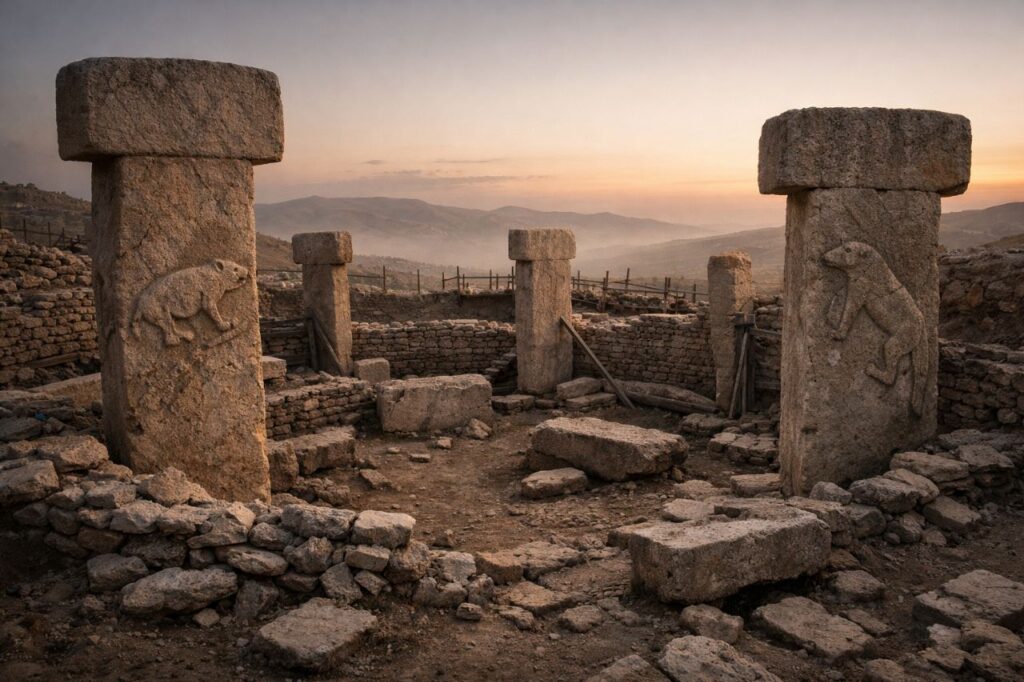
That is the first reason it grips the imagination. The accepted sequence of civilization has long seemed orderly enough: first small bands, then farming, then villages, then surplus, then temples, then cities. But Göbekli Tepe stands at the edge of that sequence like a correction made in stone. Its oldest monumental phases appear to predate pottery and belong to the Pre-Pottery Neolithic [1][3]. They belong to a world still associated with hunter-gatherers, not with the kind of organized labor usually needed for architecture on this scale. Yet there the pillars stand—some over five meters tall, weighing many tons, shaped into austere T-forms and set within carefully prepared enclosures [1][3].
Seen from a distance, the site can feel almost restrained. Bare stone. Dry earth. A rise in the landscape. But that modest first impression vanishes once the details begin to collect. The pillars were not left rough. They were carved. Foxes move across the shafts. Snakes coil. Boars, birds, aurochs, and strange abstract marks emerge from the limestone in a visual language still not fully understood [1]. Some pillars seem almost anthropomorphic, with arms, hands, belts, and loincloths suggested in relief. They are not merely supports. They appear to represent presences.
That is where the site becomes harder to reduce to a single explanation.
This was not just construction. It was staging. A place arranged to mean something.
And then comes the second shock: many of these enclosures were deliberately buried. Not toppled by war. Not forgotten under ordinary collapse. Buried. Filled in. Covered by human action. The site survived, in part, because it was hidden on purpose [1][3]. That act alone implies a ritual logic we no longer possess.
Key Facts
- Göbekli Tepe is located near Şanlıurfa in modern-day Turkey.
- The oldest layers are generally dated to the Pre-Pottery Neolithic, around the 10th millennium BCE [1][3].
- The site contains large circular and oval enclosures with monumental T-shaped limestone pillars [1].
- Some central pillars tower over the surrounding ring and likely held special symbolic importance.
- Animal carvings dominate the imagery: snakes, foxes, boars, birds, and other creatures recur throughout the site [1].
- The site appears to have been created before the full rise of settled agricultural civilization in the region [3].
- Several major enclosures were intentionally backfilled, preserving them for millennia [1][3].
- Archaeology suggests Göbekli Tepe belongs to a wider ritual landscape, not an isolated anomaly [3].
What the Scholars Say
The mainstream archaeological view is already dramatic enough. Göbekli Tepe is usually understood as a monumental ritual or ceremonial complex built by Pre-Pottery Neolithic communities [1][3]. In this reading, the site forces a revision of old assumptions rather than a rejection of archaeology itself. The builders were not primitive wanderers stumbling into complexity. They were organized, symbolically rich communities capable of planning, quarrying, carving, transporting, and coordinating labor long before urban civilization appeared.
Many archaeologists see Göbekli Tepe as evidence that ritual gathering may have helped drive social complexity rather than merely emerging from it [3]. That reverses a deeply familiar story. Instead of agriculture creating temples, one could argue that communal ritual, feasting, symbolic systems, and seasonal gathering helped create the social pressures that made agriculture more desirable or sustainable.
The carvings are often interpreted through a symbolic or cosmological lens. Dangerous animals dominate the visual field, and some scholars think the imagery reflects mythic structure, social identity, protective symbolism, mortuary practice, or a ritualized relationship with wild nature [1]. The T-shaped pillars may represent stylized human beings—perhaps ancestors, ritual presences, or beings occupying a threshold between person and symbol.
As for the burial of the site, the mainstream view does not require catastrophe or suppression. It may have been part of the site’s life cycle: ritual closure, intentional transition, or a structured act of ending and preservation.
That explanation is serious and compelling. It is also incomplete in the only way that matters: it still leaves us standing in front of an intention we can describe better than we can feel from the inside.
Alternate Theories
Some alternative researchers argue that Göbekli Tepe is not simply an early temple, but a cultural remnant from a deeper and more sophisticated forgotten world. They point to its age, symbolic density, and monumental ambition as signs that human civilization may have inherited fragments of older knowledge rather than inventing complexity from scratch.
This theory often draws strength from timing. Göbekli Tepe sits near the end of the last Ice Age, in a period shadowed by climatic upheaval and the fading of older worlds. To some, it looks less like a beginning than a survival.
Another alternative line of thought holds that the carvings and enclosure orientations preserve celestial memory. Animal figures have been read as constellational symbols or encoded references to prehistoric sky events. Some theories even connect the site to catastrophic comet impact stories or deep-time astronomical observations.
The evidence here is debated heavily, but the idea persists because Göbekli Tepe feels too ordered to many observers to be dismissed as decorative alone.
Some see the site not as a temple in the later institutional sense, but as a controlled environment for altered consciousness, initiation, ancestor mediation, or contact with the sacred dead. In this reading, the carvings are not illustrations. They are part of an immersive symbolic system meant to act on the mind.
This is the simplest and most durable alternate idea: that Göbekli Tepe reveals a level of social and symbolic sophistication modern narratives have systematically underestimated. It may not prove a lost global civilization, but it may prove that the old ladder of human progress was too neat by half.
Why It Matters
Göbekli Tepe matters because it weakens one of modern history’s most comfortable habits: the assumption that human complexity arrives in a straight line.
The site suggests that meaning, ritual, engineering effort, and symbolic power were already gathering force long before the familiar markers of civilization had settled into place. It does not erase what we know about early farming communities, but it does complicate it in a way that should not be domesticated too quickly.
More than that, Göbekli Tepe changes the emotional texture of prehistory. It reminds us that people living ten thousand years ago were not waiting passively for history to begin. They were already shaping landscapes, encoding worlds of belief into stone, and returning to places that mattered enough to build, maintain, and eventually bury with intention.
That matters intellectually. It matters archaeologically. But it also matters at a deeper imaginative level. We like origins to be simple. Göbekli Tepe refuses simplicity. It tells us that the roots of civilization may be tangled in ritual, fear, memory, death, sky, and gathering in ways we have only begun to understand.
Open Questions
- Why were the enclosures at Göbekli Tepe intentionally buried?
- What exactly do the T-shaped pillars represent?
- Why do certain animal symbols repeat so strongly across the site?
- Was Göbekli Tepe primarily local, or did it draw groups from a much wider ritual geography?
- Did ritual gathering help produce agriculture, rather than the other way around?
- Are the carvings purely symbolic, or do they preserve encoded memory we have not yet learned to read?
- Does Göbekli Tepe represent the beginning of monumental religion—or the surviving echo of something older?
Sources
[1] German Archaeological Institute (DAI) research on Göbekli Tepe
[2] UNESCO World Heritage documentation on Göbekli Tepe
[3] Published archaeological research on the Pre-Pottery Neolithic and ritual landscapes of southeastern Anatolia
[4] General scholarly reporting on Klaus Schmidt’s excavation work and later reassessment of the site