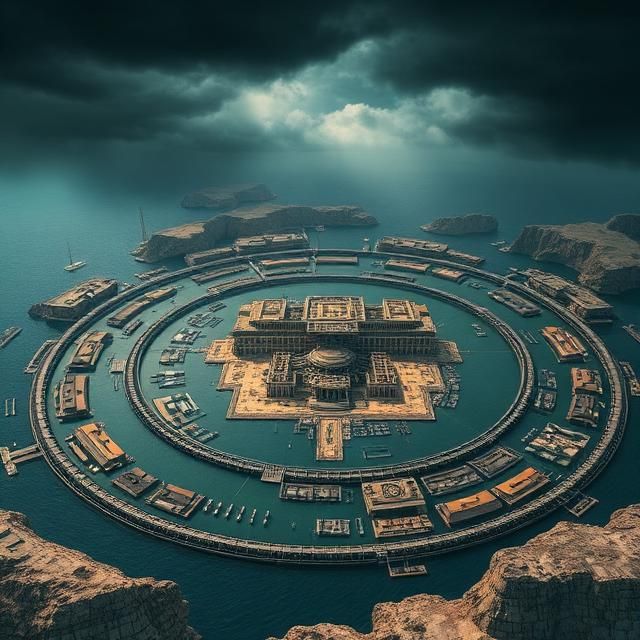
Location: Described by Plato as beyond the Pillars of Heracles, often associated with the Atlantic approaches
Estimated Period: First described in classical antiquity, said to belong to a far earlier age Primary Sources: Plato’s Timaeus and Critias [1][2]
Defining Feature: A powerful island civilization said to have fallen in a single catastrophe
Notable Details: Ringed capital layout, imperial power, moral decline, sudden destruction Archaeological Status: Unconfirmed; no accepted site has been proven to be Atlantis [3][4]
The Island That Refuses to Sink in the Mind
Some places survive by stone. Others survive by inscription. Atlantis survives by argument.
It enters the record not as a rumor gathered from taverns or sailors, but as a polished philosophical story placed in the mouth of Critias by Plato. That alone should have made it easier to classify. Instead it made the problem harder. Plato was too serious a writer to dismiss lightly and too artful a writer to trust carelessly. Ever since, Atlantis has remained suspended between literature and memory, allegory and lost geography, cautionary tale and historical echo [1][2].
That uncertainty is the source of its power. If Atlantis were merely a fable, it would have settled into the same quiet shelf that holds countless ancient inventions. If it were conclusively found, the mystery would harden into archaeology. Instead it occupies the harder ground in between. It is a civilization described in detail, placed in a world we almost recognize, then removed from us by water, time, and the suspicion that we may be reading history through a mask.
Plato describes a rich island kingdom beyond the Pillars of Heracles, larger than Libya and Asia Minor together, mighty at sea, architecturally refined, and ultimately corrupted by its own decline. Then comes the end that made the story immortal: in a single day and night of misfortune, the island sinks and vanishes beneath the sea [1][2]. The image is almost too complete. That is part of why it endures.
Atlantis is not just a lost city. It is the idea of a lost world told with enough structure to keep dragging the imagination back.
Key Facts
- Atlantis appears primarily in Plato’s dialogues Timaeus and Critias [1][2].
- In the story, the account is said to have passed from Egyptian priests to Solon, then through later retelling into the present conversation [1].
- Plato places Atlantis beyond the Pillars of Heracles, usually identified with the Strait of Gibraltar [1][3].
- The Atlanteans are described as wealthy, technically capable, expansionist, and increasingly morally compromised [2].
- The capital is described with concentric rings of land and water, monumental works, temples, harbors, and engineered channels [2].
- No archaeological site has been accepted by mainstream scholarship as the confirmed location of Atlantis [3][4].
- Proposed locations have included the Atlantic, the Mediterranean, Santorini, southern Spain, North Africa, and purely symbolic or fictional readings [3][4].
What the Scholars Say
The mainstream scholarly position is cautious and fairly consistent: Atlantis is generally treated as a literary construction used by Plato for philosophical and political purposes rather than a straightforward historical report [3][4]. That view does not come from hostility to mystery. It comes from genre, context, and the way Plato writes. He often builds arguments through idealized cities, moral contrasts, and carefully arranged dialogue. Atlantis fits too neatly into that architecture to be accepted uncritically as recovered history.
In that reading, Atlantis functions as a warning. It is the image of a powerful state swollen by wealth, ambition, and moral failure, set against a virtuous opposing civilization. The flood and sinking are not just spectacle. They are judgment, compression, and dramatic closure.
There are also historical reasons for caution. The scale Plato gives the island is difficult to reconcile with known geography as written. The transmission chain is distant. Critias itself is unfinished. And despite centuries of searching, no site has emerged that closes the question in a way the evidence can bear [3][4].
Still, the scholarly case against Atlantis as literal history does not entirely dissolve the problem. Plato chose details. He gave dimensions, layouts, lineages, maritime reach, metals, temples, and topography. That density keeps the account from feeling like a throwaway invention. Even when scholars read it as philosophical fiction, they often concede that Plato may have braided older flood memories, Bronze Age collapse echoes, or inherited Mediterranean disaster traditions into the final shape of the story [3][4].
Alternate Theories
The most familiar alternative interpretation is that Atlantis preserves memory of a real disaster later enlarged by retelling. In this view, Plato did not invent the entire thing from nothing. He inherited a fractured account—perhaps from Egyptian tradition, perhaps from wider Mediterranean memory—and gave it literary form. Santorini and the destruction associated with the Minoan world are often brought into this discussion, not because the match is perfect, but because catastrophe, maritime power, and cultural shock already live there in historical form [3][4].
Another alternative theory places Atlantis in the Atlantic world proper, treating Plato’s geographic language more directly. Over the years, researchers have pointed toward the Azores, submerged banks, Iberian coastal zones, or now-lost shorelines altered by sea-level change. Most of these proposals remain unproven. But they persist because Atlantis is one of the few ancient stories that seems to demand a map.
A more symbolic interpretation still treats the account as carrying memory, just not cartographic memory. Atlantis, in this reading, is the recurring human story of splendor followed by collapse. The drowned island becomes a vessel for civilizational amnesia: the fear that advanced societies can disappear so completely that only stylized fragments survive. That helps explain why the story adapts so easily to different eras. Each age quietly rebuilds Atlantis in its own image, then watches it sink again.
There are also esoteric readings that make Atlantis not merely a place, but a lost source of wisdom, science, or primordial religion. Those interpretations move far beyond what the classical texts can prove, yet they have endured because Atlantis has always attracted more than geographical curiosity. It attracts origin-hunger. People do not only want to know where Atlantis was. They want to know whether something great was lost before recorded history fully steadied itself.
Why It Matters
Atlantis matters because it is one of the oldest and most durable stories ever told about civilizational disappearance.
It sits at the meeting point of several obsessions that never quite leave us alone: the seduction of golden ages, the terror of sudden catastrophe, the suspicion that history is incomplete, and the fear that pride and complexity can carry the seed of collapse inside themselves. Plato may have used Atlantis for his own philosophical reasons, but the story outgrew that frame long ago.
It also matters because it sharpens an important distinction. Some mysteries endure because the evidence is abundant but confusing. Atlantis endures because the evidence is thin but the image is overpowering. That combination is rare. It creates a subject that cannot be settled by appetite alone. The desire for Atlantis is immense. The proof is not.
And still the story remains useful. It reminds us that ancient texts are not simple containers. They are active things. They preserve memory, shape imagination, and sometimes blur the line between warning and witness. Atlantis may not be recoverable as a drowned empire. But as a pressure point in the human imagination, it is as real as ever.
Open Questions
- Did Plato intend Atlantis as philosophical fiction, historical memory, or a deliberate fusion of both?
- Does the story preserve echoes of a real Bronze Age or earlier catastrophe [3][4]?
- Why did Plato describe Atlantis with such dense architectural and geographic detail if the island was entirely invented?
- Is the location beyond the Pillars of Heracles meant literally, rhetorically, or both [1]?
- Why has no proposed site persuaded the scholarly mainstream despite centuries of searching [4]?
- Does Atlantis endure because it points to a real lost place, or because it gives permanent form to the fear of civilizational collapse?
Sources
[1] Plato, Timaeus
[2] Plato, Critias
[3] Encyclopaedia Britannica, Atlantis entry and classical context
[4] General scholarly analysis of Plato’s Atlantis tradition, Mediterranean catastrophe theories, and historical interpretation