Location: Northern South America, especially the Andes and Guiana regions
Estimated Emergence of Legend: 16th century Spanish colonial era
Primary Material: Gold as ritual symbol, political wealth, and imagined city-scale treasure
Defining Feature: A legendary golden ruler or golden city said to exist beyond the mapped edge of empire
The first shape of El Dorado was smaller than the legend that swallowed it. It may not even have been a city at all. In the earliest accounts, the phrase pointed toward a person — the gilded one — a ruler associated with a Muisca ritual in which gold dust, water, and sacred offering met in a ceremony near Lake Guatavita in present-day Colombia [1][2]. That is the quiet irony at the center of the story. What later became a lost city, then a hidden kingdom, then a continental obsession, may have started as a misunderstood report of ritual kingship.
Still, small stories do not stay small when empire gets hold of them.
Spanish conquest had already shown Europe that American civilizations possessed astonishing wealth in worked gold, silver, and ceremonial objects [3]. Once that fact was established, every fragment of rumor began to harden into possibility. If the Mexica had Tenochtitlan and the Inca had Cuzco, then why should there not be another kingdom farther inland, richer still, untouched and waiting? That was the logic. It was thin, but it was enough.
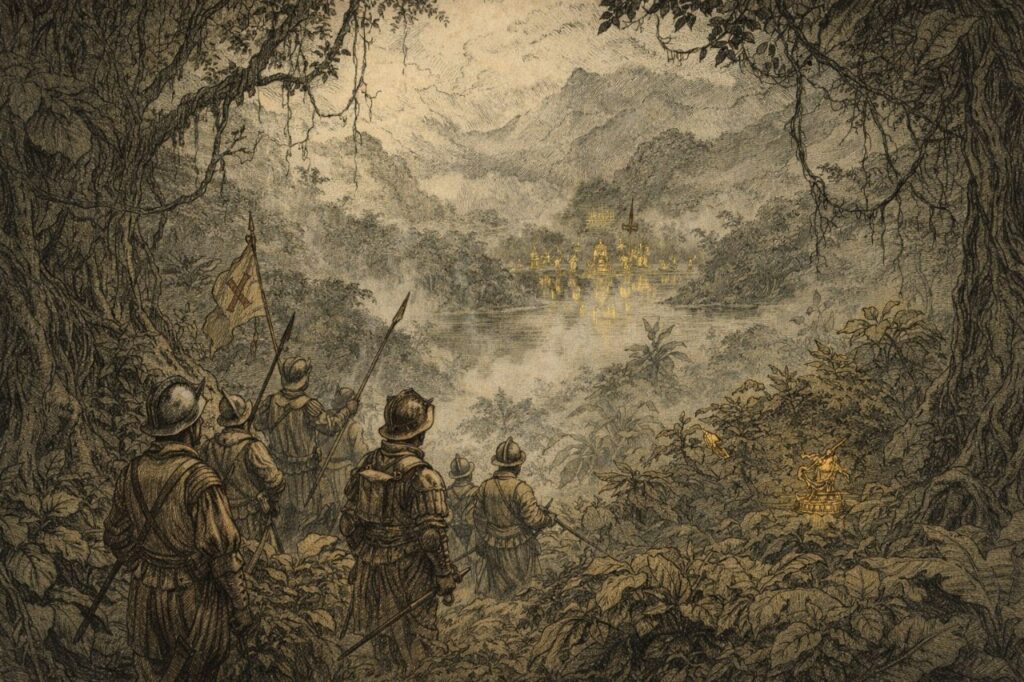
And so the legend changed. El Dorado stopped being one man and began turning into a place. Then it turned into a horizon. Men marched toward it carrying maps, armor, priests, horses, fever, greed, and a sort of exhausted faith that somewhere beyond the next river bend there would be proof that all the misery behind them had been worth it.
The Ritual Behind the Myth
The strongest historical root of El Dorado lies in Muisca tradition. Chroniclers described the accession ritual of a new ruler who, according to later retellings, covered himself in powdered gold before entering a sacred lake on a raft to make offerings [1][2]. Gold objects were cast into the water, not as currency, but as votive gifts. That difference matters. European readers often understood gold almost exclusively as wealth. Many Indigenous cultures of the region treated it as sacred material, symbolic power, or ritual offering, something closer to sunlight made solid than mere money.
This may be the point where misunderstanding became destiny. Reports of a gold-covered ruler and a lake filled with offerings did not remain ethnographic details for long. They fed a colonial imagination already primed by conquest. The result was predictable. Ritual became treasure map.
Lake Guatavita itself drew repeated attempts at recovery. Conquistadors and later treasure seekers tried draining it, cutting channels into its rim, and probing its bed for offerings [4]. Some gold objects were indeed recovered over time, enough to keep the legend breathing. But partial finds often make legends worse, not better. A little evidence can ignite far more fantasy than a clean answer ever could.
The Search Moves East
Once the idea detached from its original ritual context, El Dorado drifted across geography. It appeared in the Orinoco basin, in the Guianas, in the Andes, in territories mapped badly or not at all. Chroniclers and expedition leaders began linking it to another name, Manoa, a golden city supposedly near the great Lake Parime [5]. On maps of the 16th and 17th centuries, this imagined lake and city gained an almost official reality simply because they were copied often enough.
This is one of the stranger habits of old empires. Cartography could turn uncertainty into confidence by repetition. Draw the phantom lake once, then draw it again, and after a while the question changes. People stop asking whether it exists and start asking how to reach it.
Expeditions followed that logic into some of the harshest landscapes in South America. Dense forest, flooded lowlands, mountain passes, disease, supply collapse, desertion, starvation — all of it gathered around the search. Gonzalo Pizarro’s venture east of Quito in the 1540s disintegrated into catastrophe, and Francisco de Orellana’s desperate breakaway eventually became the first European navigation of the Amazon River [6]. The route produced no golden kingdom. It did produce one of the great survival epics of the age.
That pattern kept repeating. Failure widened the myth instead of killing it. If one route found nothing, the city must lie farther east. If one witness contradicted another, the stronger explanation was not that the story had frayed, but that the true city remained hidden. El Dorado became very difficult to disprove because it kept moving ahead of contact.
Sir Walter Raleigh and the Imperial Version of the Dream
No figure did more to formalize El Dorado in the English-speaking imagination than Sir Walter Raleigh. In *The Discoverie of the Large, Rich, and Bewtiful Empyre of Guiana* (1596), Raleigh described Guiana as a land of immense promise and suggested that the great city of Manoa lay within reach [7]. The work is part travel narrative, part political persuasion, part imperial sales pitch. It carries the mood of someone trying not merely to report a possibility but to authorize it.
Raleigh’s account matters because it fused treasure legend with state ambition. El Dorado was no longer just a private obsession for desperate captains. It became a potential imperial prize. Wealth, strategic advantage, and glory combined into one shining object beyond the frontier.
But Raleigh never found the city. Nobody did. His later expedition ended in failure and scandal, and the dream that had helped elevate him also helped ruin him [7]. There is a harsh symmetry in that. El Dorado enriched many stories. It enriched very few lives.
What the Scholars Say
Mainstream historians generally treat El Dorado as an evolving colonial legend rooted partly in real Indigenous practices and partly in European projection [1][3]. The Muisca ritual at Lake Guatavita is taken seriously as a historical source for the earliest form of the story, while the later visions of a hidden city or vast golden kingdom are understood as expansions born from conquest, rumor, and the economics of empire [2][4].
Archaeology supports the broader reality that northern South America contained complex societies, trade systems, ritual economies, and impressive material cultures. What it does not support is a literal golden metropolis waiting intact in the jungle for Europeans to discover [3]. In that sense, El Dorado belongs to the same family of legends as many frontier myths: it reveals the desires of those searching at least as much as it reveals the lands they entered.
Still, scholars do not dismiss the legend as meaningless fantasy. It had real consequences. It shaped exploration routes, colonial policy, cartography, violence, and the written image of South America in Europe. A myth can be false in one sense and historically powerful in another.
Alternate Theories and Speculative Views
Alternative interpretations persist, and some are more thoughtful than others. One view holds that El Dorado was not a single city but a distorted memory of several wealthy ceremonial centers or politically linked regions whose resources were exaggerated by outsiders. That possibility is not absurd. Colonial witnesses often misunderstood what they were seeing, and fragmented intelligence from multiple societies can easily collapse into one grand destination.
Another speculative view suggests that the core reports pointed toward a genuine inland polity whose scale or wealth was later magnified beyond recognition. The Guiana highlands, river systems, and poorly mapped interior long preserved enough uncertainty for such ideas to survive. The problem is less that they are impossible than that hard evidence remains thin.
There is also the symbolic interpretation, which I think deserves more respect than it usually gets. In this reading, El Dorado functioned as a moving image of abundance — a place that had to remain just beyond reach or it would stop being useful to the men chasing it. It was imperial hunger converted into geography.
That may sound literary, but it fits the evidence rather well.
Why It Matters
El Dorado matters because it sits at the collision point of ritual truth, colonial misunderstanding, greed, and myth-making. It shows how a real ceremonial world can be translated badly, then enlarged, then weaponized by people who arrive already convinced that unimaginable wealth must be hiding somewhere nearby.
It also matters because the legend altered history on the ground. Men died for it. Expeditions shattered against terrain they could not read. Indigenous societies were pulled into a violent search for a place that may never have existed in the form imagined by Europeans. The costs were not mythical.
And yet the story refuses to die because it still speaks to something old and dangerous in the human mind. The belief that beyond the last ridge, beyond the next river, beyond the blank place on the map, there waits a concentrated answer to all loss and effort. A city of gold is only one version of that dream.
Open Questions
How closely did the earliest El Dorado reports reflect actual Muisca ritual practice at Lake Guatavita [1][2]? What Indigenous political networks or ceremonial landscapes may have been compressed into later visions of a single hidden city? Why did Lake Parime and Manoa remain so durable in European maps long after direct proof failed to appear [5]? How much of the legend’s expansion came from misunderstanding, and how much from deliberate exaggeration meant to attract backing and prestige [7]? Did the search for El Dorado conceal more localized discoveries that were never fully understood because explorers were chasing a grander illusion?
Sources
[1] Encyclopaedia Britannica — El Dorado legend and early association with a gilded ruler among the Muisca
[2] Encyclopaedia Britannica — Muisca and Lake Guatavita ritual tradition tied to offerings and rulership
[3] Encyclopaedia Britannica — Spanish conquest context and European expectations of American wealth
[4] Encyclopaedia Britannica — Repeated attempts to drain Lake Guatavita and recover offerings
[5] Encyclopaedia Britannica — Later association of El Dorado with Manoa and Lake Parime in Guiana
[6] Encyclopaedia Britannica — Gonzalo Pizarro expedition and Orellana’s Amazon crossing in the search for wealth inland
[7] Encyclopaedia Britannica — Sir Walter Raleigh’s Guiana account and the political expansion of the El Dorado legend