Quick Reference Facts
Location: Salisbury Plain, Wiltshire, England
Estimated Construction: c. 3000 BCE to 1600 BCE in major phases
Primary Material: Sarsen sandstone and smaller bluestones
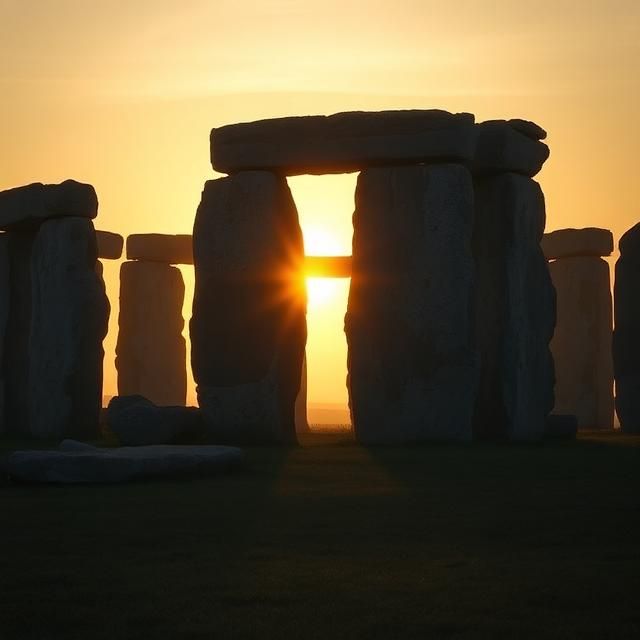
Defining Feature: Monumental stone circle aligned with the solstices
Stonehenge has one of those names that seems too familiar to still be mysterious. People know the silhouette. They know the standing stones. They know the summer solstice photographs and the textbook summaries and the rough idea that it is very old. And because they know those things, they often imagine the deeper mystery has already been settled.
It has not.
The monument stands on Salisbury Plain with a kind of silent authority that only very old structures seem to possess. It does not sprawl like a ruined city. It does not bury itself in decorative detail. It is austere, exposed, and almost severe. A ring of immense upright stones, crowned in places by lintels, with smaller imported stones set within, and a larger ceremonial landscape stretching beyond it. Even now, after centuries of study, excavation, argument, and restoration, Stonehenge retains the unsettling quality of a message that can be read in part but never fully translated.
That quality is what has kept it alive in the imagination.
Archaeologists understand much more about Stonehenge than people once did. It was not built all at once, but in phases over many centuries.[1] The site began as an earthwork enclosure, then developed into a more elaborate ceremonial space, and finally into the stone monument that dominates discussion today.[2] Burials, timber structures, pits, processional routes, and neighboring ritual sites all connect it to a larger sacred landscape rather than an isolated wonder.[3] In that sense, Stonehenge is not one mystery but several layered together across time.
Even the stones themselves tell a divided story. The larger sarsens came from Marlborough Downs, not especially near, but still within the range of difficult overland transport.[4] The smaller bluestones appear to have come from west Wales, a far more astonishing journey.[5] However exactly they arrived, they represent movement, planning, labor, and coordination on a scale that was once badly underestimated. Stonehenge was not the work of a primitive people fumbling toward monumentality. It was the work of communities capable of logistics, symbolism, memory, and extraordinary patience.
That matters, because older popular writing often tried to flatten the achievement by treating ancient builders as simple-minded unless proven otherwise. Stonehenge quietly resists that insult. The monument suggests a population with ritual purpose, engineering sense, and a long view of continuity. It also suggests the ability to preserve and transmit meaning across generations, because no single lifespan could have carried the full project from beginning to end.
The mainstream scholarly view is that Stonehenge functioned as a ceremonial and ritual center whose meaning changed over time.[6] That is cautious language, but it fits the evidence. The alignment with the solstices is real and important.[7] The placement of the stones, especially in relation to the midsummer sunrise and midwinter sunset, points toward a deliberate cosmological design rather than accidental orientation.[8] For many researchers, that makes Stonehenge not a general-purpose “calendar” in the modern sense, but a monumental ritual structure tied to sacred time, seasonal transition, and the movement of the sky.[9]
That interpretation gains strength from the wider landscape. The Avenue, the nearby River Avon, the burial evidence, and the relationship to sites like Durrington Walls all suggest ceremony, procession, and structured movement through symbolic space.[10] Stonehenge may have been less a place of ordinary congregation than a stage for particular rites, perhaps involving ancestors, seasonal observance, political identity, or some combination of all three.
Yet the phrase “ritual center” can become too convenient if used lazily. It explains just enough to sound satisfying while leaving the deepest emotional question untouched. Ritual for what? To accomplish what? To honor whom? We can say the monument was meaningful, but meaning is not the same as motive. Stonehenge is full of motive without narrative. That is one reason it still disturbs the modern mind. We are not used to encountering a project so vast whose builders left no written declaration beside it.
For that reason, alternate theories have never disappeared. Some suggest Stonehenge was a center of healing because of the unusual origin of the bluestones and the burial evidence around the site.[11] Others propose it served as a place of elite gathering and social unification, where dispersed communities renewed political and spiritual ties.[12] There are also interpretations that emphasize sound, vibration, or altered experience, arguing that the spatial arrangement may have shaped not just movement and sightlines, but perception itself.[13]
These ideas vary in strength, but none are entirely frivolous. A monument built over generations, aligned to celestial events, connected to burial practices, and anchored in a larger sacred landscape was almost certainly doing more than one thing at once. The modern urge to compress it into a single function may be part of the problem. Stonehenge could have been funerary, ceremonial, political, astronomical, and ancestral in overlapping ways, with different emphases in different periods.
There are also more speculative views, some of them older and more romantic, that frame Stonehenge as the inheritance of a lost priesthood or a surviving fragment of a more advanced prehistoric knowledge system. These interpretations often lean heavily on the monument’s geometry, transport difficulty, and alignment precision.[14] While the evidence does not require a vanished super-civilization, the persistence of such theories tells us something real: Stonehenge feels larger than the tidy categories imposed on it. Even measured analysis does not entirely dissolve its aura.
And then there is the question of how it was built, which still has its own power. Experimental archaeology has shown that large stones can be moved and raised using plausible ancient methods, with timber, sledges, ropes, ramps, leverage, and disciplined labor.[15] That is useful knowledge. But it does not make the achievement small. A thing can be technically possible and still astonishing. In some ways, proving that ordinary human effort could have done it only deepens the wonder. It means that collective belief, not magic, was strong enough to bend generations toward a monument that outlived all of them.
Stonehenge also matters because it forces a confrontation with prehistoric intention. Written history spoils us. It lets rulers explain themselves, priests justify rituals, and societies describe their own sacred order in their own words. Stonehenge belongs to a world before that convenience. The monument remains, but the inner speech of its builders is gone. What survives is stone, alignment, burial, landscape, and pattern. Enough to know that intelligence was there. Not enough to hear it clearly.
That gap is where the mystery lives.
It is tempting to say that Stonehenge has been “solved” because we know more than we once did. But knowledge does not always produce closure. Sometimes it only sharpens the outline of what remains unresolved. We know it was built in stages. We know the solstitial alignment was deliberate. We know the stones came from different regions. We know the monument was embedded in a ceremonial landscape. We know the site mattered profoundly.
What we do not know, at least not in the satisfying modern sense, is what final meaning the builders believed they were securing there. Were they binding the living to the dead? Marking sacred authority? Mirroring the sky to stabilize the earth below it? Creating a place where time itself became visible in stone? Those possibilities are not interchangeable. But neither can any one of them fully silence the others.
That is why Stonehenge still refuses to explain itself. Not because nothing is known, but because what is known keeps stopping just short of the final disclosure. It gives us engineering without confession, alignment without doctrine, and endurance without commentary.
There are monuments that survive as ruins, and there are monuments that survive as arguments. Stonehenge is the second kind. It continues to stand not merely as a relic of prehistoric Britain, but as a challenge to modern certainty. The stones remain in place, battered by weather, photographed endlessly, studied carefully, and never quite reduced to one stable meaning.
That may be the deepest reason it endures. Stonehenge is not only ancient. It is unresolved in a way that feels permanent.
For a monument built to anchor something in time, that is a fitting legacy.
Sources
1. English Heritage, “Stonehenge History and Research.” 2. Historic England, “Stonehenge and Associated Monuments.” 3. Mike Parker Pearson, Stonehenge: Exploring the Greatest Stone Age Mystery. 4. English Heritage, “The Sarsens of Stonehenge.” 5. National Museum Wales, “The Bluestones of Stonehenge.” 6. Timothy Darvill, Stonehenge: The Biography of a Landscape. 7. English Heritage, “Solstice at Stonehenge.” 8. R. J. C. Atkinson, Stonehenge. 9. Parker Pearson et al., Antiquity studies on Stonehenge and Durrington Walls. 10. UNESCO World Heritage listing for Stonehenge, Avebury and Associated Sites. 11. Timothy Darvill and Geoffrey Wainwright, research on Stonehenge and healing theory. 12. Mike Parker Pearson, research on feasting, movement, and social cohesion. 13. Rupert Till, archaeoacoustics discussions related to Stonehenge. 14. John North, Stonehenge: Neolithic Man and the Cosmos. 15. Experimental archaeology summaries from English Heritage and related reconstructions.