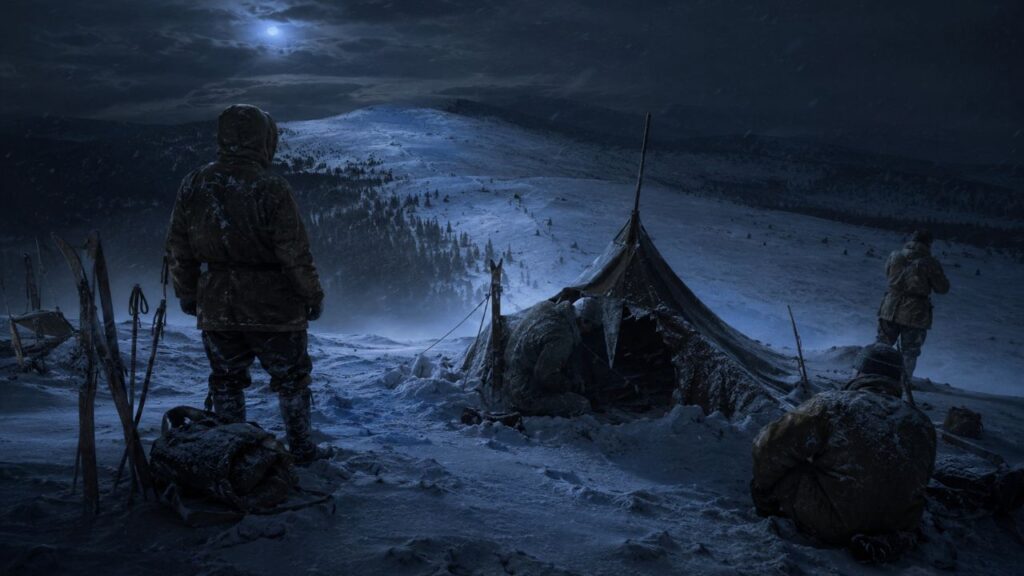
Location: Eastern slope of Kholat Syakhl in the northern Ural Mountains, in what is now Sverdlovsk Oblast, Russia [1][2]
Date of Incident: Night of February 1-2, 1959 [1][2] Expedition Group: Nine experienced hikers from the Ural Polytechnical Institute after Yuri Yudin turned back early due to illness [1][2]
Defining Feature: Their tent was cut open from inside, and the group fled into brutal cold with inadequate clothing before being found scattered across the slope and nearby woods [1][2]
Enduring Mystery: The case combines harsh mountain conditions, unusual injuries, a thin official record, and decades of competing explanations [2][3][4]
The Night on Dead Mountain
Some mysteries survive because the facts are missing. The Dyatlov Pass Incident survives because the facts that do exist are so stark that they seem to resist ordinary arrangement. Nine skilled hikers set out into the northern Urals in the winter of 1959. They were young, experienced, organized, and led by Igor Dyatlov, a radio engineering student with the credentials to guide a difficult expedition. One member, Yuri Yudin, turned back before the final ascent because of illness. That decision saved his life. The remaining nine pressed on toward Otorten through worsening weather and established camp on the exposed slope of Kholat Syakhl, a name often translated as Dead Mountain [1][2].
Weeks later, searchers found their tent partly collapsed and slashed from within. Boots, coats, and basic supplies were still inside. Footprints led away from the shelter into the dark. The first bodies appeared near a cedar tree at the forest edge, underdressed and close to the remains of a small fire. Others lay between the tree and the tent, as if they had tried to fight their way back uphill. The last four were found much later under deep snow in a ravine, some with major internal trauma. Those details are the engine of the case. They do not look clean. They do not look theatrical either. They look like the remains of panic, cold, injury, and a decision made under pressure that no one has ever fully reconstructed to universal satisfaction [1][2][3].
The original Soviet investigation closed with language that has haunted the story ever since: the hikers had died because of a compelling natural force. That phrase explained almost nothing and invited everything. Over the decades the Dyatlov Pass Incident became a magnet for theories involving avalanches, military tests, Mansi attackers, infrasound, secret weapons, ball lightning, cryptids, and extraterrestrial visitors. The case lives at the border where incomplete evidence, institutional mistrust, and a lethal landscape begin feeding one another [2][4].
Key Facts
- The expedition began in January 1959 and was aiming for Otorten in the northern Urals, with Dyatlov leading a group qualified for a high-difficulty winter route [1][2].
- Yuri Yudin left the expedition early because of health problems, making him the sole member of the original party to survive [1][2].
- Search teams found the tent on February 26, 1959, cut from the inside, with much of the hikers' clothing and gear left behind [2].
- Six of the nine deaths were attributed to hypothermia, while three involved severe traumatic injuries, including chest and skull damage [2][3].
- Some of the more disturbing details, such as missing soft tissue on faces, became central to the legend, though exposure, time, water, and scavenging complicate those details [2][3].
- In 2020, Russian prosecutors said an avalanche or snow slab event was the most likely cause, and a 2021 study in Communications Earth and Environment argued that a delayed slab avalanche was physically plausible at the site [3][4].
Mainstream Theories
The mainstream explanation today is no longer simple exposure by itself. It is a sequence. The hikers likely faced an immediate threat near the tent, abandoned it quickly, and then failed to recover once they were on the slope in darkness, high wind, and extreme cold. The strongest modern version of that sequence centers on a small delayed slab avalanche or similar snow-slab release above the tent [3][4].
That theory matters because it tries to explain several of the case's strangest features at once. The tent had been cut from inside. The group left without proper clothing. Some of them suffered serious blunt trauma. Critics long argued that the slope was too shallow for an avalanche and that rescuers saw no classic avalanche field. The 2021 modeling work by Johan Gaume and Alexander Puzrin proposed a more specific mechanism: the group cut into the slope to pitch the tent, strong winds loaded snow above them over time, and a compact slab later released with enough force to create injury and panic without producing the giant cinematic avalanche people expected to see [3].
That interpretation does not claim every mystery is solved. It argues something narrower and more serious: that a limited snow event could have forced the hikers out quickly, injured some of them, and started the fatal cascade. Once they were downslope, the environment did the rest. The cold was intense, visibility was poor, and the group seems to have split into survival efforts rather than moving as a single unit. A fire was lit. A snow shelter or den appears to have been attempted near the ravine. Clothing seems to have been redistributed from the dead to the living. What had begun as a mountain emergency became a slow collapse of options [2][3][4].
There is also a more conservative mainstream view that does not insist on a full avalanche but still assumes a natural trigger at the tent. In that version, fear of a slide, violent wind loading, or some sudden snowpack instability may have been enough to drive the group out into the dark. The important point is that the modern mainstream has moved away from exotic intervention and toward a high-stress mountain survival failure shaped by weather, terrain, and the hikers' urgent decisions under uncertainty [3][4].
Alternate Theories
The Dyatlov Pass Incident remains famous because the evidence still leaves room for argument, and because some pieces of the record arrived to the public late, incompletely, or through a Soviet system few people trusted. That distrust helped alternate theories flourish.
One long-running cluster of theories involves secret military activity. Witness reports of glowing spheres in the wider region, the Cold War setting, and the original investigation's vague language encouraged speculation about rockets, weapons tests, or classified field exercises. Some versions imagine blast trauma or toxic exposure. Others suggest the hikers stumbled into something they were never meant to see. These theories retain emotional force because they fit the era, but publicly available evidence has never pinned the deaths to a specific military event with the same coherence that the snow-slab model offers [2][4].
Another family of theories points to human conflict. Local Mansi people were suspected early on by some outsiders, largely because the location was remote and the deaths were frightening. That suspicion has long been considered weak. There was little evidence of a direct armed attack, and the Mansi themselves helped in search efforts. Criminal assault theories, prisoner-escape stories, and covert-agent scenarios suffer from a similar problem: they can explain fear, but they explain the physical scene badly unless extra assumptions are stacked on top [2].
Then there are the paranormal explanations that gave the case part of its enduring pop mythology. Yeti attacks, UFOs, ball lightning, and infrasound panic all rose in different retellings. They survive because the case contains the exact ingredients paranormal culture loves: wilderness, winter, youth, a damaged camp, official ambiguity, and bodies found in impossible-looking positions. Yet these explanations usually depend less on hard evidence than on the atmosphere surrounding the event. They are powerful as folklore and weak as reconstruction.
The most reasonable alternate position is not that a monster or spacecraft appeared on the mountain. It is that the case may never reduce to one neat mechanism. A snow event may have forced the evacuation, but trauma, navigation errors, group fragmentation, shelter failure, and the long delay before recovery may each have shaped what the searchers later found. In other words, the mystery may persist not because the answer is supernatural, but because several bad factors struck in sequence and left a scene that looked stranger than the chain that produced it [2][3][4].
Why It Matters
The Dyatlov Pass Incident matters because it is one of the rare modern mysteries where the landscape itself feels like a participant. This was not an artifact dug from antiquity or a legend retold across centuries. It was a documented twentieth-century expedition with cameras, diaries, route plans, and named victims. That should have made it easier to close. Instead it made the case more unsettling. The deaths occurred close enough to the modern world to feel solvable, but far enough from certainty that every recovered detail became fuel for competing narratives [2][3].
It also matters because the story reveals how mystery is manufactured. Some of it comes from nature. Some of it comes from institutions. The Soviet investigation produced just enough formal explanation to end the file, but not enough clarity to build public confidence. Later reopenings, new forensic interest, and modern snow science did not erase the folklore. They joined it. The Dyatlov case became a textbook example of how partial records and charged political climates can turn a deadly accident into a cultural myth that outlives everyone involved [3][4].
There is a human dimension that should not be lost beneath the speculation. These were not stock characters in a campfire tale. They were students and young professionals undertaking a difficult winter route with the confidence and seriousness that such expeditions required. The case still carries weight because the victims were competent enough that people want incompetence ruled out. If experienced people can be broken apart so completely by weather, terrain, and one wrong decision in the night, the mountain feels larger and colder than explanation itself.
Open Questions
- Did a slab avalanche fully account for the injuries and the abrupt evacuation, or only for the first moments of the crisis [3]?
- Why did the original investigation phrase the cause so vaguely instead of describing a clearer natural-hazard scenario if one was suspected [2][4]?
- How much did delayed recovery, snow movement, meltwater, and scavenging distort the evidence before the last bodies were found [2][3]?
- Can every major alternate theory now be dismissed with confidence, or do some pieces of the record still resist the current mainstream model [2][3][4]?
- Why has this one mountain tragedy remained globally mythic while other cold-weather expedition deaths faded into specialist history?
Sources
[1] Encyclopaedia Britannica, background overview on the Dyatlov Pass incident, expedition route, and discovery of the campsite.
[2] National Geographic, "Has science solved one of history's greatest adventure mysteries?" updated May 17, 2023.
[3] Johan Gaume and Alexander M. Puzrin, "Mechanisms of slab avalanche release and impact in the Dyatlov Pass incident in 1959," Communications Earth and Environment, 2021.
[4] Reuters, "Russia blames avalanche for 1959 Urals mountain tragedy," July 11, 2020, and related reporting on the reopened Russian review.