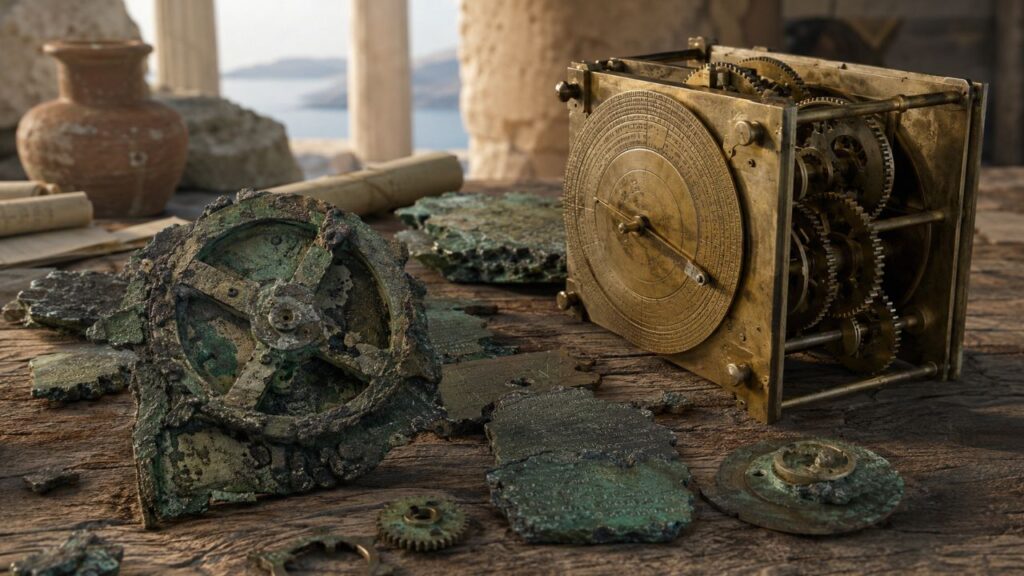
Location: Recovered from a shipwreck off Antikythera, between Crete and the Peloponnese, and now held in Athens [1][3]
Estimated Construction: Late second century BCE, probably around 150-100 BCE [1][2][3]
Primary Material: Corroded bronze gears and plates once housed in a wooden case [1][2]
Defining Feature: A hand-powered geared device that modeled celestial cycles, eclipse patterns, and calendrical systems with startling precision [1][2][3]
Archaeological Importance: The most complex known surviving mechanism from antiquity and the clearest proof that Hellenistic engineers built advanced mathematical instruments [1][2][4]
The Machine in the Wreck
When the Antikythera Mechanism first came up from the sea, it did not look like a lost machine from a brilliant age. It looked like a ruin. Sponge divers working the wreck off Antikythera in 1900 recovered statues, luxury goods, and broken bronze. Among them was a corroded lump that seemed less important than the marble bodies and bronze faces hauled up beside it. Only later, when a gear tooth became visible inside the crust, did the thing begin to change shape in the historical imagination [1][3].
It has never really stopped changing.
The mechanism survives now as fragments: broken plates, inscriptions, gear trains, a wreck of thought as much as metal. Yet those fragments are enough to show that someone in the Greek world built a compact device capable of tracking cycles of the Sun and Moon, predicting eclipses, and coordinating several calendars and long astronomical periods [1][2]. The effect is almost indecent. We are used to antiquity leaving temples, epics, bronze helmets, and stone graves. We are less comfortable with it leaving a geared cosmos in a box.
That discomfort is part of the machine's power. The Antikythera Mechanism is not mysterious because no one knows what it did. On the contrary, the broad outline is now much clearer than it was a generation ago. It is mysterious because the surviving object proves a level of instrument-making that feels larger than the surviving tradition around it. The fragments tell us that this machine existed. They also imply a deeper workshop culture behind it, and that hidden background is where the real unease begins [1][2][4].
Key Facts
- The Antikythera Mechanism was recovered from a Roman-era shipwreck discovered by sponge divers near Antikythera in 1900, with the relevant fragments brought up in 1900-1901 [1][3].
- Surviving remains are divided into dozens of fragments, preserving about thirty bronze gears and extensive Greek inscriptions [1][2][4].
- Its dials and gear trains tracked lunar phases, eclipse cycles, and calendrical periods such as the Metonic and Saros cycles [1][2].
- Research using X-ray computed tomography and advanced surface imaging dramatically improved the reading of inscriptions and the reconstruction of internal gearing in the twenty-first century [1][4].
- Most scholars date its manufacture to the late second century BCE, although exact calibration and workshop attribution remain debated [1][2][3].
- No other surviving device from the ancient Mediterranean matches its known complexity, which is why it still feels like an intrusion from a library that burned before history could inventory it [1][2][3].
Mainstream Theories
The mainstream picture is already extraordinary enough. The mechanism is generally understood as a Greek astronomical calculator built in the Hellenistic world, probably in the second century BCE, and carried aboard a ship that later sank off Antikythera [1][3]. It was not a toy. It was a working instrument. Turn the handle and pointers on its faces moved through cycles that linked observation, prediction, and calendar keeping.
The evidence for that is strong. The gearing that survives, combined with the inscriptions recovered through imaging, shows a device that modeled the motion of the Sun and Moon, displayed lunar phase, and tracked long cycles used to predict eclipses [1][2][4]. The rear dials are especially important: spiral displays tied to the Metonic cycle and the Saros cycle make it clear that this was a machine for compressing celestial recurrence into something portable and readable. It translated the heavens into bronze ratios [1][2].
The front of the mechanism remains more damaged, but not blank. Researchers have argued that it included displays for the zodiac, the Egyptian calendar, and probably additional pointers for the known planets of Greek astronomy [1][2]. Some parts of that reconstruction are firmer than others. The point is not that every wheel is settled beyond dispute. The point is that the device belongs to a mature scientific culture in which geometry, observation, and craftsmanship were already meeting inside precision instruments.
That culture did not come from nowhere. By the Hellenistic period, Greek mathematicians and astronomers had inherited Babylonian observational traditions, developed geometric models of celestial cycles, and built a language for turning periodic motions into calculable systems. The mechanism looks less like an isolated miracle when set against that intellectual background, though it still looks like a masterpiece [1][2][3]. It may have been associated, directly or indirectly, with the scientific traditions connected to Rhodes, Hipparchus, or later workshop networks that translated theory into brass and pin-and-slot motion. The exact line of descent remains uncertain. The level of competence does not [1][2].
There is also the matter of the inscriptions. These are not decorative flourishes. They function more like operating notes, labels, and explanatory text. In a sense, the machine carried part of its own user manual on its surfaces [4]. That matters because it suggests the object was meant to be read as well as turned. It was explanatory technology, not merely hidden mechanism.
Alternate Theories
The more speculative views begin where the gaps remain. One enduring question is whether the Antikythera Mechanism was rare even in its own time, or whether it is only rare now because almost everything comparable was melted down, broken, or lost at sea. The second possibility is not unreasonable. Bronze is a recyclable material, and delicate scientific devices do not survive catastrophe well. If that is true, then the mechanism may be the lone survivor of a vanished instrument tradition that was once richer than the evidence now allows [2][4].
Other interpretations go further. Some writers have suggested that the mechanism points to a level of ancient engineering history that standard narratives still undersell, not because the machine is impossible, but because it survived in such isolation. In that reading, the real mystery is not the device itself but the silence around its cousins. Where are the workshop remains, the discarded gears, the intermediate models, the catalog of parallel instruments? It is not absurd to think they existed. It is simply difficult to prove [2][3].
There are also arguments about how complete our reconstructions really are. The front display, in particular, has invited competing models. Some reconstructions include elaborate planetary trains. Others accept a more cautious picture built only from the best-preserved evidence [1][2]. The disagreement is useful. It reminds us that reconstruction is not resurrection. Even with modern imaging, scholars are still negotiating between inscription, gear geometry, and missing metal.
Then there is the oldest, roughest speculation of all: that the mechanism somehow does not fit its age. That claim tends to appear whenever people confront the machine outside historical context. But the more one studies Hellenistic mathematics, astronomy, and craftsmanship, the less alien the device becomes. Strange, yes. Unprecedented in the surviving record, yes. Untethered from Greek science, no [1][2][3]. The better mystery is harder and more interesting: how much sophisticated ancient instrumentation once existed, and how much of that world has simply failed to survive.
Why It Matters
The Antikythera Mechanism matters because it changes the emotional scale of the ancient world. Plenty of ancient achievements are impressive in bulk. This one is impressive in compression. It takes cycles that belong to the sky and folds them into a hand-operated device small enough to fit in a case. The machine is intimate in size and vast in ambition.
It also matters because it blurs categories that modern people like to keep separate. We call it a calculator, a calendar computer, a model of the cosmos, an astronomical instrument. All of those are partly right [1][2][3]. But the object also belonged to a world where astronomy touched religion, navigation, civic timekeeping, omen traditions, and philosophical order. Predicting an eclipse was not merely technical. It was a way of placing human life inside recurrence.
There is something else. The Antikythera Mechanism is one of the few artifacts from antiquity that feels less primitive the closer it is examined. Usually distance flatters the past and detail shrinks it. Here detail does the opposite. Every new scan, inscription reading, or gear analysis makes the object less romantic and more formidable [1][4]. It becomes harder to mythologize cheaply and harder to dismiss.
That is why the mechanism still unsettles people. It is not just old. It is intelligent in a way that still feels contemporary. It reflects a confidence that the world could be modeled, divided into cycles, and made graspable through craftsmanship. The machine did not abolish mystery. It mechanized part of it.
Open Questions
- Who designed the Antikythera Mechanism, and in what workshop tradition was that skill maintained [1][2]?
- How complete are the current reconstructions of the front display and any planetary indicators [1][2]?
- Was this object a luxury singularity, or one surviving example from a broader class of lost scientific instruments [2][4]?
- What exact calibration date best fits the surviving inscriptions, hole counts, and astronomical assumptions [2]?
- Why did no similarly complete geared device from the ancient Mediterranean survive to stand beside it?
Sources
[1] Tony Freeth et al., "Decoding the ancient Greek astronomical calculator known as the Antikythera Mechanism," Nature 444, 2006.
[2] Tony Freeth et al., "A Model of the Cosmos in the ancient Greek Antikythera Mechanism," Scientific Reports 11, 2021.
[3] Encyclopaedia Britannica, "Antikythera mechanism," reference overview of discovery, date, and purpose.
[4] Antikythera Mechanism Research Project and related inscription studies on imaging, labels, and reconstruction history.