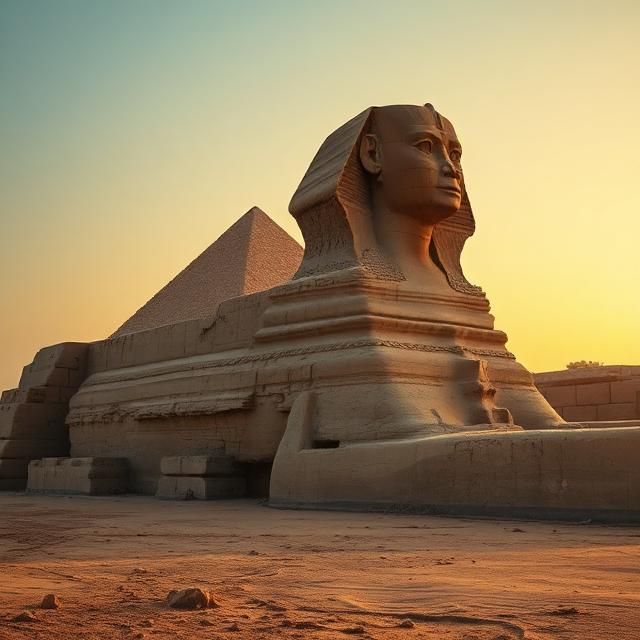
The Sphinx, Water Erosion, and the Question of Hidden Chambers EXCERPT: Few monuments on earth stand so clearly in history while still attracting arguments that feel as old as myth itself.
Location: Giza Plateau, Egypt [1][2]
Estimated Construction: Commonly dated to the reign of Khafre in the Old Kingdom, around the mid-3rd millennium BCE [1][2]
Primary Material: Carved limestone bedrock with later restoration blocks [1][2]
Defining Feature: Monumental leonine body with a human head, facing east toward the rising sun [1][2]
Notable Debate: Whether weathering on the body points mainly to wind and sand, or whether prolonged rainfall played a larger role in its early history [2][3] Associated Mystery: Repeated traditions and modern speculation about hidden chambers, sealed passages, and lost archives beneath or around the monument [3][4] Historical Status: Securely real, intensely studied, and still open to dispute in certain key interpretations [1][2]
The Monument That Refuses to Sit Still in History
At dawn the Great Sphinx does not look ruined first. It looks watchful.
That may be why arguments cling to it so fiercely. Plenty of ancient monuments are old, damaged, and incomplete. The Sphinx is something else. It sits on the Giza Plateau in full view of scholarship, tourism, cameras, excavators, and empires long dead, and still manages to feel as if part of its story was withheld on purpose. Not hidden in a melodramatic sense, maybe. Just withheld. The stone says enough to start the argument, not enough to end it.
The mainstream case places the Sphinx in the Old Kingdom, usually within the orbit of Pharaoh Khafre, whose pyramid and valley temple stand nearby [1][2]. That interpretation is not casual. It rests on archaeological context, quarry relationships, the broader Giza building program, and the logic of royal monumentality. Still, the monument has a way of unsettling clean conclusions. Its weathering, its damaged face, the long cycles of burial and excavation, the old habit of Egypt building on top of older memory — all of that leaves room for a certain pressure in the mind.
And once that pressure is there, two questions return again and again.
Was the Sphinx shaped in a climate older and wetter than orthodox chronology comfortably allows?
And is there anything beneath it still waiting to be found?
Key Facts
The Great Sphinx of Giza is carved directly from limestone bedrock on the Giza Plateau, with later repairs added in masonry where the stone had deteriorated [1][2]. The monument combines a recumbent lion’s body with a royal human head and was almost certainly intended as an image of power, kingship, guardianship, and cosmic order. It faces east. That orientation has always mattered.
The most widely accepted view connects the Sphinx with Khafre, a Fourth Dynasty ruler whose pyramid complex lies immediately nearby [1][2]. Quarry and enclosure relationships are a major part of that argument. The stone removed to shape the enclosure appears to correlate with material used in nearby temple structures, tying the monument into the larger architectural logic of Giza.
The Sphinx was not continuously visible through history. Sand buried large portions of it for long stretches, and much of its known history involves clearing, restoring, and reinterpreting it [2]. That fact alone complicates modern confidence. A monument that spends centuries emerging and disappearing will naturally generate layered explanations.
Its nose is gone, its beard partly survives only in fragments, and restoration efforts from different periods have left their own marks. So when people speak of the Sphinx as if it were one untouched statement from one moment in time, that is already too simple.
What the Scholars Say
Mainstream Egyptology places the Sphinx in the Old Kingdom, most often around the reign of Khafre, c. 2558–2532 BCE [1][2]. This view is built less on a single inscription than on archaeological context. The monument sits in a coherent royal landscape. The enclosure, adjacent temples, quarrying evidence, and stylistic associations all suggest a Fourth Dynasty date, even if some details remain argued over.
That position is not without nuance. Scholars are well aware that the Sphinx has undergone extensive weathering and repeated restoration, and they do not all describe its damage in the same terms. But the dominant interpretation explains most erosion through long-term exposure, salt weathering, groundwater effects, and wind-driven sand acting over centuries in a complicated desert environment [2][3]. In other words, the orthodox case does not deny heavy erosion. It disputes the claim that rainfall must be the primary explanation.
The chamber question is treated just as cautiously. Subsurface surveys, seismic work, and ground studies over the years have identified anomalies, fissures, cavities, and structural irregularities in and around the plateau, but anomalies are not the same as secret libraries [3][4]. Limestone landscapes crack. Void spaces happen. Ancient construction cuts through older geology. Scholars tend to insist on that distinction because too many dramatic conclusions have been announced from too little.
The conservative answer, then, is plain enough: the Sphinx belongs to Old Kingdom Giza, its damage can be explained within known geological processes, and no verified hidden archive has yet been demonstrated beneath it.
That answer is solid. It is also, to some people, a little too settled for a monument like this.
The Water Erosion Debate
The water erosion argument is the most persistent challenge to the standard chronology. In broad terms, it claims that portions of the Sphinx enclosure and body show weathering patterns more consistent with prolonged rainfall than with wind and sand alone [3]. If that interpretation were correct in the strongest version, the implication would be difficult to contain: the monument, or at least major parts of its carved context, could point back to a much wetter climatic phase — perhaps much earlier than the Fourth Dynasty.
That is why the theory attracts so much attention. It does not merely tweak a date. It threatens to rearrange the timeline around one of the most famous monuments in the world.
Advocates of the theory often point to rounded, vertically undulating erosion features on enclosure walls and compare them with what they see as sharper wind-carved profiles elsewhere [3]. They argue that the amount and character of weathering suggest sustained precipitation acting over long periods, not just occasional moisture and desert abrasion. In its boldest form, the theory hints at an origin reaching into predynastic antiquity, or at least to an inherited monument reworked by later pharaonic builders.
Mainstream geologists and Egyptologists push back hard on that reading. They note the variability of the limestone itself, the role of salt exfoliation, the influence of groundwater and capillary action, and the simple danger of treating a single monument as if its weathering can be interpreted in isolation from all the other known conditions of the plateau [2][3]. Their objection is not only chronological. It is methodological. Extraordinary dating claims, they argue, require more than morphology read at a dramatic angle.
Still, the debate endures because the monument itself gives it oxygen. The Sphinx enclosure does not feel finished in the way a neat textbook wants ancient evidence to feel finished. It feels battered, layered, argued over by stone as much as by scholars. And that leaves a seam open.
Hidden Chambers and the Dream of a Buried Archive
If the water erosion debate is geological, the chamber debate is almost architectural in imagination.
For generations, people have suspected that the Sphinx conceals something below: ritual chambers, sealed tunnels, symbolic voids, construction spaces, hidden passages, perhaps even records from a forgotten age [3][4]. Some of that suspicion comes from modern scans and surveys. Some comes from older traditions about sacred knowledge hidden beneath the plateau. Some comes, frankly, from the monument’s posture itself. It does not look accidental. It looks placed over meaning.
There have been legitimate investigations. Seismic studies and other subsurface methods have reported cavities or anomalies in the area, though interpreting those signals is another matter [3][4]. Natural fissures in limestone terrain are not exotic. Nor are voids created by human activity elsewhere on the plateau. The problem is not that every anomaly is fake. It is that anomalies are easy to mythologize long before they are understood.
Then there is the larger legend — the so-called Hall of Records, often imagined as a hidden repository of primeval knowledge somewhere under the Sphinx or nearby [4]. This idea has become deeply entangled with esoteric traditions, psychic claims, speculative archaeology, and modern mythmaking. From a strict evidentiary standpoint, it remains unverified. That should be said plainly. But the legend persists because it fits the Sphinx too well in symbolic terms. A guardian without a secret feels almost incomplete to people.
And maybe that is the deeper issue. Once a civilization places a colossal watcher at the edge of its dead, its kings, and its horizon, later ages begin assuming the watcher must be watching something.
Why It Matters
The Sphinx matters because it tests the boundary between secure history and unresolved interpretation better than almost any monument on earth.
This is not a case where scholarship has nothing to say. It has a great deal to say, and much of it is persuasive. Nor is it a case where speculation automatically deserves equal weight just because it is alluring. That would be lazy. But the Sphinx continues to matter because even responsible study has not drained it of atmosphere. The monument remains historically grounded and emotionally unstable at the same time.
That combination is rare.
It also matters because the water-erosion question, if ever resolved decisively in favor of an earlier date, would have consequences far beyond one sculpture. It would reopen questions about inherited sacred sites, lost phases of construction, and how much of the ancient world may have been built on memories already old when dynastic history began.
And if no such revision comes — if the orthodox dating remains the soundest conclusion — the Sphinx still stands as a lesson in how ancient monuments accumulate secondary mysteries simply by surviving longer than the certainty of the people who study them.
Open Questions
Why does the Sphinx continue to generate chronological doubt despite its strong archaeological setting at Giza [1][2]?
Are the disputed erosion patterns best explained by rainfall, by mixed geological processes, or by some sequence not yet fully modeled [2][3]?
Do subsurface anomalies around the monument represent ordinary geological voids, construction features, or something more deliberate [3][4]?
How much of the Sphinx we see now belongs to its first carving, and how much belongs to long cycles of repair and reinterpretation?
If the monument once had associated chambers, inscriptions, or ritual spaces now lost, would we even know how to recognize them cleanly after so many centuries of burial and restoration?
Sources
[1] Encyclopaedia Britannica entries on the Great Sphinx and the Giza complex
[2] General Egyptological scholarship on Khafre, the Fourth Dynasty, and monument context at Giza
[3] Geological and archaeological discussions of Sphinx enclosure weathering and the rainfall debate
[4] Studies, reports, and modern reference discussions concerning subsurface anomalies, chamber claims, and the Hall of Records tradition