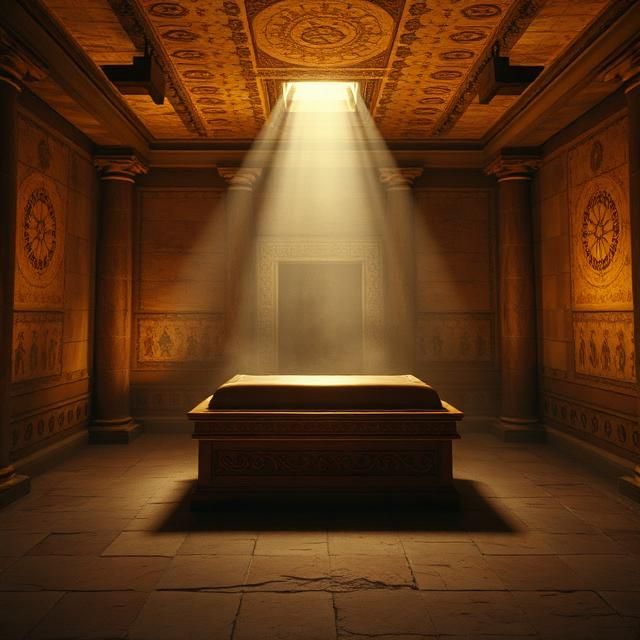
Location: Traditionally associated with Alexandria in Egypt, though competing theories place the burial in Siwa Oasis, Memphis, Venice, or an unknown concealed chamber [1][2]
Estimated Period: Alexander died in 323 BCE; his body was embalmed and transported during the early Hellenistic age [1][2]
Primary Material: A royal funerary body prepared in precious wrappings and reportedly housed in an elaborate coffin or sarcophagus, with later accounts describing gold and glass elements [2][3]
Defining Feature: The missing burial place of Alexander III of Macedon, one of antiquity’s most documented conquerors and one of history’s most elusive dead rulers [1][2]
Notable Traditions: Burial in Alexandria’s royal quarter, relocation by Ptolemaic rulers, visits by Roman emperors, destruction by urban upheaval, hidden transfer, and alternate burial-site claims [2][3][4] Historical Status: Alexander’s funeral procession is historical, his tomb was famous in antiquity, but its final location remains unverified [1][2][4]
The King Who Conquered the World but Vanished in Death
Few historical figures seem less likely to disappear than Alexander the Great. His life cut a path across the ancient world so violently and so brilliantly that entire cities, dynasties, and languages were forced to reorganize themselves around his memory. He did not die in obscurity. He died as the most dangerous political legacy on earth.
And yet his tomb is missing.
That absence is what gives the story its peculiar voltage. Lost kings are common enough in early history. Alexander is different. His campaigns were recorded. His body was fought over. His funeral arrangements became a matter of statecraft. Ancient writers speak of a burial so famous that rulers and emperors came to see it with their own eyes [1][2][3]. For a time, his remains were not hidden at all. They were among the great trophies of the ancient Mediterranean world.
Then the trail frayed.
Somewhere between dynastic collapse, urban violence, religious change, earthquakes, coastal instability, looting, rebuilding, and the ordinary brutality of time, the most famous tomb in the Hellenistic world slipped out of confirmed history. That should not have happened. Which is precisely why the mystery endures.
Alexander’s lost burial is not merely a missing grave. It is the disappearance of a symbolic center. Find the tomb, and one does not merely recover bones. One reopens the question of how antiquity handled the body of a man who had already become more than a man while he was alive.
Key Facts
- Alexander III of Macedon died in Babylon in 323 BCE at the age of thirty-two [1].
- Ancient sources indicate that his embalmed body became the focus of political struggle among his successors [1][2].
- The funeral carriage and transfer of the body became a major episode in the early Hellenistic power struggle, especially involving Ptolemy [2][3].
- Most classical traditions place Alexander’s tomb in Alexandria, where it remained famous for centuries [2][4].
- Several Roman leaders, including Augustus, are said to have visited or viewed the tomb [2][3].
- By late antiquity, the location of the tomb had become uncertain, and no verified archaeological discovery has resolved the matter [2][4].
What the Sources and Scholars Say
The mainstream historical position begins with a point that is easy to miss: the existence of Alexander’s tomb is not the doubtful part. Antiquity treated it as a real and important place. Ancient writers describe the custody of his body, the struggle to possess it, and the prestige attached to being associated with his remains [1][2][3]. The problem is not whether such a tomb existed. The problem is where it ended up.
Most scholars place the strongest historical weight on Alexandria. After Alexander’s death in Babylon, his successors understood that whoever controlled his body could borrow a little of his legitimacy. Ptolemy’s intervention in the funeral route is one of the central episodes in that story. The body appears to have been brought to Egypt, first associated with Memphis in some traditions and then with Alexandria, where later rulers incorporated the tomb into the ceremonial and political life of the city [2][3].
For centuries, that makes good sense. Alexandria was not only a capital but a stage set for dynastic memory. Alexander’s presence there would have served the Ptolemies well. Roman-era references reinforce the impression that the tomb remained visible and famous long after the age of the first successors had passed [2][3].
The trouble comes later. Ancient testimony becomes thinner, more scattered, and increasingly difficult to reconcile with the physical history of Alexandria itself. The royal quarter shifted, decayed, was rebuilt, and may now lie beneath dense urban layers or submerged zones affected by earthquakes and coastal change [2][4]. If the tomb remained where it was supposed to be, it may now be buried beneath a city that never stopped moving.
That is the sober scholarly answer: Alexander was almost certainly buried with immense ceremony, probably in Egypt, very likely in Alexandria at some stage, and then lost through the cumulative violence of time rather than through one clean dramatic event. It is a convincing answer. It is also incomplete enough to leave the door open.
Alternate Theories
The most persistent alternative theories begin by refusing to let Alexandria have a monopoly on the final chapter. Some researchers and local traditions argue that Alexander may have been buried elsewhere from the beginning, or reburied later under conditions no official record preserved. Siwa Oasis appears often in these discussions because Alexander famously visited the oracle of Ammon there and seems to have attached deep symbolic importance to the place [2][4]. A burial near Siwa would have matched the religious drama of his self-presentation, even if the evidence remains unproven.
Others keep the body in Egypt but move it through time. In this view, the tomb once stood openly in Alexandria and was later concealed, dismantled, or transferred during a period of danger. Urban riots, anti-pagan destruction, political upheaval, or grave robbing could all have forced a relocation that entered rumor but not durable record [2][3]. The appeal of this theory lies in its realism. Sacred and royal remains were often moved when regimes changed. Silence in the sources does not necessarily mean nothing happened.
There are also more radical identifications. Over the years, various tombs have been proposed as Alexander’s by resemblance, inscription fragments, or historical intuition. The most famous modern claim linked the richly decorated tomb at Amphipolis to Alexander’s wider dynastic circle, though no consensus has accepted it as his own burial [4]. Other arguments stretch farther still, tracing relic routes or body confusion across the eastern Mediterranean. These remain speculative, but they survive because the official ending feels too untidy for a figure of such scale.
And then there is the deeper possibility behind all such theories: that Alexander’s corpse was never merely funerary matter. It was political power in preserved form. If later rulers feared what it represented, concealment might have been preferable to display. A lost tomb, in that sense, may not be an accident at all. It may be the last deliberate act in a very old contest over inheritance.
Why It Matters
Alexander’s tomb matters because it sits where history, empire, and myth overlap almost perfectly. His campaigns changed borders, trade, language, military culture, and the mental map of the ancient world. To lose his burial is to lose one of the clearest physical anchors to that transformation [1][2].
It also matters because tombs are never only about the dead. They are about custody. They reveal who claims legitimacy, who preserves memory, and who decides how greatness will be staged for the generations that follow. In antiquity, the body of a ruler could become a political instrument long after the mind had gone silent. Alexander’s remains were almost certainly treated that way [2][3].
There is something more unsettling here as well. Alexander spent his life forcing the known world open. He crossed deserts, stormed citadels, besieged island cities, and marched beyond familiar maps. The irony that his own body then passed beyond the map has helped keep the mystery alive. The conqueror of distance became, in death, a problem of location.
That paradox is difficult to resist. A confirmed tomb would not just satisfy archaeological curiosity. It would collapse a long corridor of speculation and place one of history’s most mythic lives back inside the earth.
Open Questions
- Was Alexander’s final resting place always intended to be Alexandria, or was that only one stage in a more complex funerary journey [2][3]?
- Did the tomb vanish through destruction, gradual burial beneath the modern city, or deliberate concealment?
- How much weight should be given to the Siwa tradition and other alternate burial-site claims [2][4]?
- Could coastal subsidence and the shifting fabric of Alexandria explain why no decisive trace has been found?
- Were Alexander’s remains ever moved in late antiquity to protect them from looting or ideological destruction?
- If the tomb were found, would it be identifiable beyond reasonable doubt, or would the argument simply change shape?
Sources
[1] Arrian, Plutarch, and other classical accounts of Alexander’s death and legacy
[2] Encyclopaedia Britannica and standard historical scholarship on Alexander the Great and Hellenistic Egypt
[3] Ancient testimonies concerning Ptolemy, the transport of Alexander’s body, and Roman visits to the tomb
[4] Modern archaeological and historical discussions of Alexandria, Siwa, Amphipolis, and competing tomb-location theories