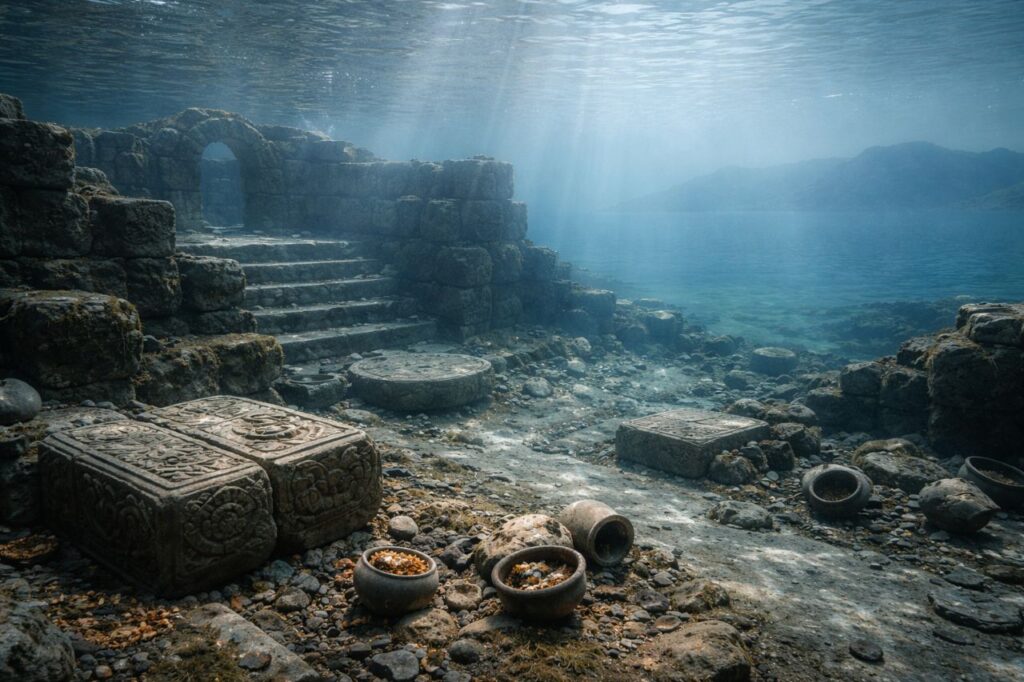
Location: Lake Titicaca on the border of Bolivia and Peru, especially the Khoa Reef area near the Island of the Sun [1][2]
Estimated Construction: Primarily associated with the Tiwanaku horizon and later Andean ritual use, roughly first millennium CE with deeper legendary associations [1][2]
Primary Material: Worked stone, carved anchors, ceramic offerings, and ritual objects recovered from the lake bed [1][2]
Defining Feature: Submerged ruins and offerings in one of the Andes’ most sacred high-altitude lakes, long tied to origin traditions and ceremonial pilgrimage [2][3]
Notable Traditions: Inca origin myths place the birth of the sun and founding ancestors in this lake, while archaeological finds suggest formal ritual activity on and beneath the water [2][3] Historical Status: The underwater remains are real, but their full extent, chronology, and symbolic purpose remain debated [1][2]
Lake of Origins, Lake of Stone
At more than twelve thousand feet above sea level, Lake Titicaca does not feel like an ordinary body of water. It feels elevated in every sense: geographically, mythically, and psychologically. The air is thin, the light severe, and the blue surface can look less like a lake than a sheet of sky pinned between mountains. For centuries, peoples of the central Andes treated it not as scenery but as a place where worlds touched.
That is why the underwater ruins matter. If stones, walls, anchors, and offerings truly rest beneath these waters in ceremonial patterns, then the mystery is not simply whether ancient builders placed objects on the lake floor. The deeper question is what they believed the water was doing there. Was it a sacred threshold? A ritual archive? A drowned precinct once tied to temples on the islands above? Or are later legends pulling modern imagination deeper than the evidence can safely carry?
Lake Titicaca rewards restraint and tempts speculation in equal measure. Archaeology has confirmed submerged cultural material near sacred zones of the lake, especially around the Island of the Sun and Khoa Reef [1][2]. Yet every confirmed find seems to widen the imaginative field rather than close it. The Andes preserved a memory of this place as a source of divine emergence. The water, in that sense, was never empty. It was occupied by story long before divers entered it.
Key Facts
- Lake Titicaca was a major sacred landscape for pre-Inca and Inca societies, not merely a transport or subsistence zone [2][3].
- Underwater surveys have recovered stone structures, carved objects, ceramic fragments, and ritual offerings in parts of the lake [1][2].
- Some of the strongest evidence comes from the Khoa Reef area near the Island of the Sun, a place already central to Andean sacred geography [1][2].
- Archaeologists have identified offerings consistent with pilgrimage and ceremonial deposition rather than random discard [1][2].
- Inca traditions linked Lake Titicaca to cosmic beginnings, including the emergence of the sun and founding ancestors [3].
- The exact relationship between the submerged remains, changing lake levels, and ritual architecture on nearby islands is still unresolved [1][2].
What the Archaeology Supports
The mainstream interpretation begins with an important correction: the phrase underwater ruins can sound more dramatic than the evidence sometimes warrants. Scholars are not describing a lost Atlantis in the Andes. They are describing a real ritual landscape in which built features, offerings, and culturally placed materials now lie beneath water [1][2]. That distinction matters. It keeps the mystery grounded.
Excavation and underwater survey in the Titicaca basin have shown that the lake was heavily integrated into ceremonial life. Near the Island of the Sun, archaeologists have recovered incense burners, ceramics, gold objects, shell materials, and stone features from underwater contexts that strongly suggest deliberate ritual deposition [1][2]. These finds align with what is already known from terrestrial archaeology: this was a place of pilgrimage, political theater, and sacred legitimacy.
There are several plausible ways such remains reached the lake bed. Some objects were almost certainly offered directly into the water. Others may mark small submerged platforms, boundary structures, or installations associated with processions and controlled ritual access. Changing shorelines and fluctuating lake levels over long periods could also have altered the relationship between architecture and water, leaving once-accessible features submerged [1][2].
This is why cautious scholars prefer to speak in terms of ceremonial landscapes and submerged contexts rather than sensational lost cities. The evidence does support significance. It supports formal use. It supports sacred intentionality. But it does not yet support every grand claim attached to the lake.
Alternate Theories
Where evidence thins, the older mythic atmosphere rushes back in. One line of alternative interpretation holds that the submerged remains are fragments of a much larger drowned sanctuary, perhaps tied to a ceremonial complex now mostly hidden by time, sediment, and water-level change. In this view, the objects recovered so far are only the visible edge of a more substantial architecture that once coordinated processions, offerings, and elite initiation around the lake’s sacred islands.
Another theory leans on the lake’s role in origin traditions. If Titicaca was understood as a birthplace of cosmic order, then some researchers and enthusiasts argue that the underwater features may have been designed as symbolic thresholds: not temples in the ordinary sense, but ritual machines for approaching emergence, ancestry, and divine authority. That reading is difficult to prove archaeologically, yet it fits the intensity with which later Andean states curated the site [2][3].
More speculative voices push farther, suggesting that the lake preserves remnants of a forgotten proto-civilization or an Andean memory of catastrophic flooding. These ideas remain unsupported by current evidence. Still, they persist because Lake Titicaca has the right combination of altitude, antiquity, sacred narrative, and fragmentary finds to produce them. The environment itself encourages monumental thinking.
The most interesting alternative theory may also be the most modest: that we have underestimated how much ritual architecture ancient societies were willing to place in difficult environments. Modern assumptions often separate practical building from sacred symbolism. Ancient builders did not always share that divide. A partly submerged ceremonial zone may not be evidence of catastrophe at all. It may simply be evidence that sacred geography was the primary design brief.
Why It Matters
Lake Titicaca matters because it compresses archaeology and cosmology into the same space. The physical finds are significant on their own, but their real force comes from where they were found. These were not offerings dropped into anonymous water. They were deposited in a lake that Andean tradition treated as a place of beginnings [2][3].
That gives the underwater remains an unusual interpretive charge. They are not just clues to local ritual practice. They are clues to how states and pilgrim communities staged legitimacy in one of South America’s most symbolically powerful landscapes. Whoever controlled access to Titicaca’s sacred geography could claim more than territory. They could claim proximity to origin.
There is also a broader lesson here. Archaeology often advances by stripping away romance. In Lake Titicaca, the opposite sometimes happens. The more carefully the evidence is studied, the harder it becomes to dismiss the old intuition that this lake was designed, in human thought, as a threshold between visible and invisible worlds. The mystery survives not because the facts are absent, but because the facts themselves point toward deliberate sacred drama.
Open Questions
- How extensive are the submerged architectural features near Khoa Reef and other sacred zones of the lake [1][2]?
- Which remains represent direct offerings, and which belonged to built ceremonial structures?
- How much did ancient lake-level fluctuations reshape what is now interpreted as underwater archaeology?
- Were Tiwanaku and Inca ritual uses of the lake continuous in meaning, or did later powers reinterpret an older sacred landscape?
- Could future remote sensing reveal larger submerged layouts that divers have only sampled in fragments?
- At what point does the phrase underwater ruins describe architecture rather than an accumulation of sacred deposits?
Sources
[1] Christophe Delaere and colleagues, underwater archaeology studies at Lake Titicaca and the Khoa Reef ritual zone
[2] Peer-reviewed archaeological work on ritual offerings, submerged contexts, and sacred landscapes in the Titicaca basin
[3] Standard historical and ethnohistorical sources on Inca origin traditions, the Island of the Sun, and Lake Titicaca’s ceremonial importance