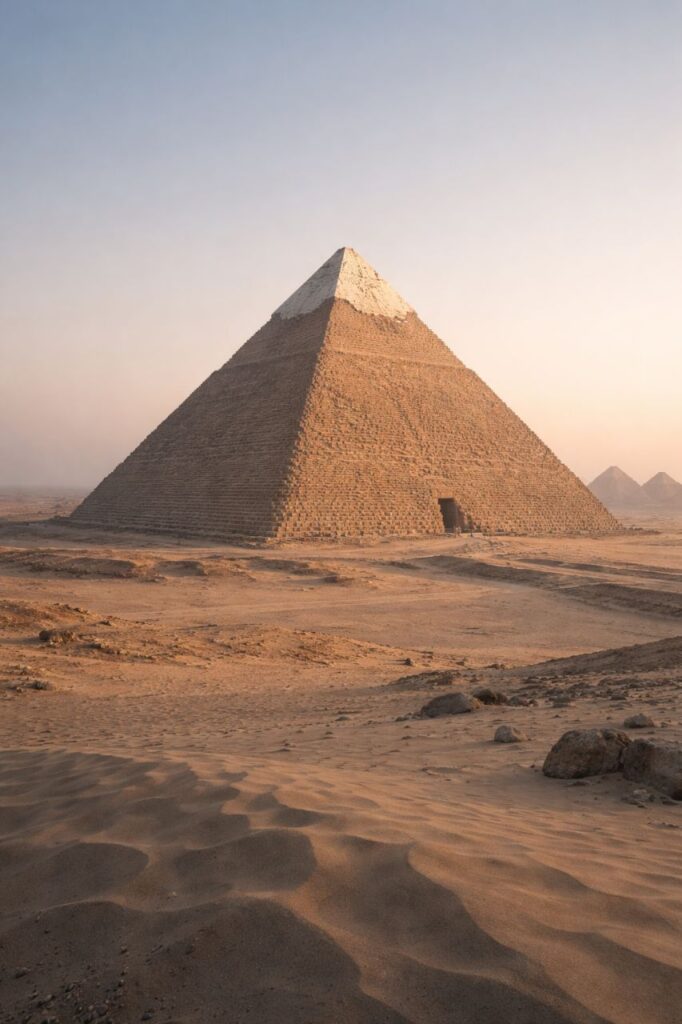
Location: Giza Plateau, near modern Cairo, Egypt [1][2]
Estimated Construction: c. 2600 BCE during the reign of Khufu of Egypt’s Fourth Dynasty [1][2]
Primary Material: Local limestone, fine Tura limestone casing, granite from Aswan, and mortar [1][2]
Defining Feature: The largest Egyptian pyramid and the only surviving wonder of the ancient world, built with internal chambers and astonishing geometric precision [1][2]
Notable Mysteries: Construction logistics, possible hidden spaces, the purpose of the shafts, and the full meaning of the monument’s design still provoke debate [2][3][4] Historical Status: Its builder, royal purpose, and broad chronology are well supported, but important technical and symbolic questions remain open [1][2][3]
The Monument That Refuses to Become Ordinary
The Great Pyramid of Giza is one of those structures that can be ruined by familiarity. It appears in textbooks, airport posters, old documentaries, and cheap internet arguments. Seen too often at a distance, it can start to feel less like a real building than a symbol for ancient ambition in general.
Then the numbers return, and the thing becomes strange again.
For more than forty centuries it stood as the tallest human-made structure on earth. It rose from the Giza Plateau with an original height of roughly 146.6 meters, built from millions of blocks and once sealed in bright casing stone that would have caught the desert sun like a blade [1][2]. Its accepted identity is straightforward enough: this was the tomb monument of Khufu, king of Egypt’s Fourth Dynasty. Yet the closer the monument is studied, the less it behaves like a solved object.
The Great Pyramid is not mysterious because scholars know nothing about it. It is mysterious because they know a great deal and still cannot close every gap. The king is known. The era is known. The funerary purpose is strongly supported. But the practical choreography of construction, the meaning of certain internal features, and the possibility of undiscovered spaces keep the monument from settling into mere certainty [1][2][3].
This is the difference between a legend and a durable archaeological mystery. The Great Pyramid does not need fantasy to remain impressive. The documented facts are already difficult enough.
Key Facts
- The Great Pyramid is widely accepted as the pyramid of Khufu, based on inscriptions, surrounding tombs, and other archaeological evidence [1][2].
- It was built during Egypt’s Old Kingdom, probably over about twenty to thirty years in the twenty-sixth century BCE [1][2].
- The monument originally had smooth white casing stones that would have given it a far sharper and brighter appearance than today [1][2].
- Its known interior includes the subterranean chamber, the so-called Queen’s Chamber, the Grand Gallery, and the King’s Chamber with a granite sarcophagus [2][3].
- Evidence from workers’ graffiti and the Diary of Merer strongly supports a state-organized Egyptian construction project rather than a lost civilization or vanished super-technology [2][4].
- Even so, major questions remain about exact building methods, internal voids, and the symbolic logic of some architectural features [2][3][4].
What the Evidence Supports
The mainstream case begins with attribution. For generations, fringe claims tried to sever the pyramid from Khufu and from dynastic Egypt altogether. That position is much harder to sustain now. Quarry marks and work-gang graffiti in relieving chambers above the King’s Chamber include Khufu’s name, and the surrounding cemetery landscape ties the monument directly to his court and family [1][2]. The discovery of the Diary of Merer was especially important because it recorded the transport of fine limestone to the monument called Akhet-Khufu, “Horizon of Khufu,” during the relevant period [4].
That does not explain every engineering detail, but it narrows the field. The pyramid was not a prehistoric ruin reused by the Egyptians. It was an Egyptian royal project, carried out with organized labor, logistics, surveying skill, and a command of stonework that still feels severe even when one avoids romantic exaggeration [1][2][4].
Its internal arrangement adds another layer of fascination. The ascending passage, the Grand Gallery, the chamber system, the granite sarcophagus, and the small shafts leading from upper chambers do not read like improvisation. They suggest a design that was carefully revised, technically ambitious, and probably symbolic as well as practical [2][3]. The unfinished subterranean chamber hints that the internal plan may have changed during construction. That kind of revision makes the monument feel less static and more like a problem solved in phases.
Construction theory remains the point where confidence softens. Egyptologists broadly agree that ramps, sledges, controlled labor teams, and careful staging can account for the monument without invoking impossible technology. But exactly which ramp configurations were used, how stone movement was sequenced at the upper levels, and how the final casing and apex were managed remain matters of active reconstruction rather than perfect proof [2][3].
That distinction matters. Saying the Great Pyramid was built by ancient Egyptians is not the same as saying every step of the process has been fully reconstructed. The evidence is strong. The last details are not all in hand.
Alternate Theories
Because the Great Pyramid is so geometrically disciplined, it invites theories larger than the available evidence. Some argue that the monument preserves a lost body of mathematical or astronomical knowledge so advanced that orthodox archaeology understates its significance. Others see the internal shafts and chamber relationships as signs of a ritual machine: a stone instrument designed to guide the king’s transformation, not simply to house his remains [2][3]. That second idea, at least in moderated form, is not entirely outside serious discussion. Egyptian monuments often fused engineering, theology, and political symbolism so tightly that modern categories can feel too narrow.
Then there are the hidden-space theories. These gained new life after muon-scan work indicated the presence of a large void above the Grand Gallery, now widely called the ScanPyramids Big Void [3]. The discovery did not prove a secret burial chamber, archive, or treasure room. It proved something more disciplined and, in its own way, more tantalizing: that the monument still contains substantial architectural space whose function is not yet securely known.
That uncertainty is enough to keep stronger speculation alive. Some think the void may be a relieving space, a construction feature, or an internal weight-management solution. Others suspect a sealed corridor or chamber connected to an earlier design phase. More adventurous interpretations imagine concealed ritual texts, royal equipment, or a hidden funerary reserve untouched by ancient robbery. There is no decisive evidence for those claims at present [3][4]. But they persist because the pyramid has earned the right to make people wonder what else is inside it.
The oldest sensational theory, of course, is that conventional Egyptology cannot possibly explain the monument at all. In its harsher forms this view credits Atlanteans, vanished global engineers, extraterrestrials, or some erased high civilization. Those ideas survive because the Great Pyramid genuinely feels disproportionate to ordinary assumptions about the ancient world. But the archaeological record does not require them. It already shows a state with immense labor capacity, symbolic ambition, and technical ability operating in a culture where royal tombs were engines of power, not side projects [1][2][4].
Why It Matters
The Great Pyramid matters because it marks the point where monumentality becomes nearly metaphysical. Other ancient structures are older in pieces, richer in decoration, or more immediately human in scale. This one is different. It seems to convert political authority into geometry.
That conversion is historical as much as aesthetic. The pyramid was part of a larger funerary complex, tied to temples, causeways, boats, officials, and the carefully managed afterlife of kingship [1][2]. It was not just a giant pile of stone. It was a royal statement about order: earthly order, cosmic order, dynastic order. The king would die, but the horizon of Khufu would remain.
It also matters because the monument disciplines speculation without killing it. That is rarer than people think. Many mysteries collapse under evidence. The Great Pyramid has done the opposite. Each new layer of evidence has made the object more grounded, yet not less compelling. The worker graffiti made the human organization clearer. The Diary of Merer made logistics clearer. The scans made internal complexity clearer. None of this dissolved the aura. It refined it [3][4].
There is a reason the monument still attracts arguments about hidden chambers, secret knowledge, or encoded alignments. Even when those arguments go too far, they are reacting to something real: the building’s stubborn excess. It feels as though it contains more intention than has yet been translated.
Open Questions
- What exact sequence of ramps, lifting methods, and staging systems was used as the monument rose toward its highest levels [2][3]?
- What is the precise function of the large void detected above the Grand Gallery [3]?
- Were the narrow shafts primarily symbolic, ventilatory, practical, or some combination of all three [2][3]?
- How much did the pyramid’s original polished casing and capstone change its visual and ritual effect on the plateau?
- Did the internal design evolve significantly during construction, and if so, why?
- How much of the monument’s power comes from engineering alone, and how much from a symbolic program that modern readers only partly grasp?
Sources
[1] Encyclopaedia Britannica and standard reference works on Khufu and the Great Pyramid of Giza
[2] Wikipedia synthesis of archaeological evidence, dimensions, internal structure, and attribution to Khufu
[3] ScanPyramids reporting and scholarly discussion on internal void detection and architectural interpretation
[4] Published discussion of the Diary of Merer, Old Kingdom logistics, and quarry-transport evidence connected to Akhet-Khufu